
As a founder, building a startup feels like pushing a rock uphill. Frustrating, exhausting, relentless, uncertain.
If you don’t give up (and you get lucky), at some point you’ll finally start to show some signs of product-market fit. Great! It’s finally working.
At this point, you’re probably pretty tired, so it’s natural to want to rest from pushing the rock uphill, at least for a bit. You might now raise another venture round, based on the traction you’re seeing.
You’ll likely start to build out your team. You have something repeatable that you can scale with more people and, if you raise money, you also have the budget.
The new team members aren’t like the very early team members. The new folks are probably more professional, and more experienced. They have playbooks. They start to do what you ask them to do: turn the success you’ve found into a repeatable and predictable process to continue to scale revenue.
You have a working company that is growing. It should be celebrated.
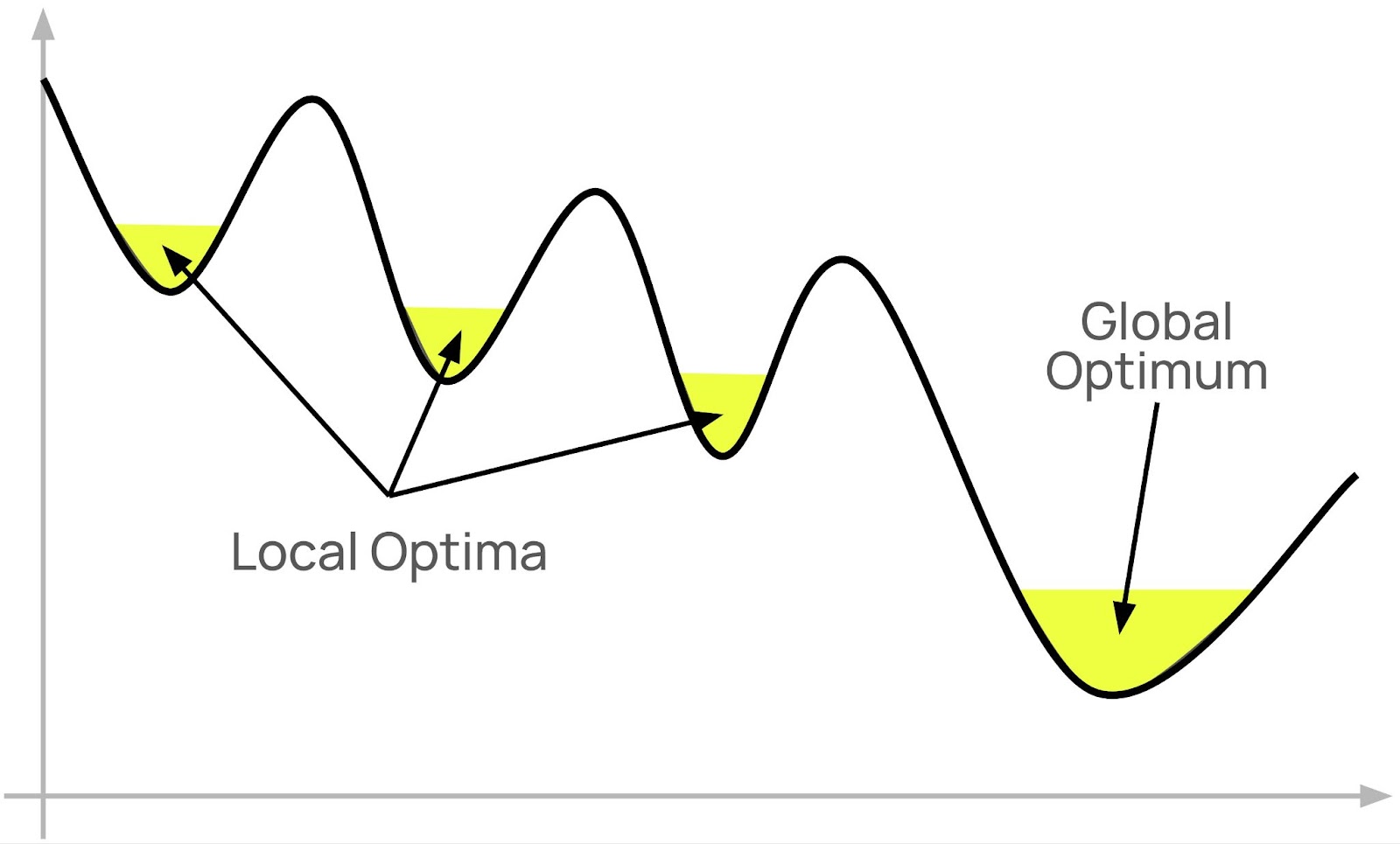
The problem is that you don’t know if you’ve found your global optimum or merely a local optimum.
Could there be an even better market, business model, product, and/or customer out there if you just keep looking; if you just keep pushing the rock uphill?
Many startups get stuck in these local optima. Why is it hard to escape them?
Firstly, everyone is telling you how important it is to focus. Do one thing well, rather than several things poorly. Great advice.
Secondly, you can unintentionally create the very inertia that keeps you stuck in the local optimum. All those people you hired once you got something working are there to maintain the local optimum: to make what’s working keep working. In fact, their jobs arguably depend on staying in the local optimum. So, they are unlikely advocates of trying something different.
There are also underlying cognitive biases at play here. Kahneman and Tversky wrote about “loss aversion” – the tendency to worry more about what you might lose from a change versus what you might gain. Others have written about “psychological inertia” and the “status quo bias”.
All of this happens against the backdrop of founders being bombarded with suggestions (many unsolicited) of things they might improve or do differently, competitors that are having success with a different model, new enablers that might be tried, etc.
I have some advice for both founders and investors on tackling this local vs global optimum challenge.
Founders:
- Remain open to the idea that you may not yet have found the global optimum for your company, even when things seem to be going relatively well.
- Reserve some mental bandwidth and resources for the ongoing pursuit of a global optimum. The whole point of a local optimum is that it takes initial effort to get out of it before you can continue to a better place. Conduct small experiments to explore options that may find better optima.
- Be rigorously data-driven. To make sure you are comparing apples-to-apples, make sure you are comparing unit economics between options. I would argue that the Y-axis on the chart above should be CAC doubling time.
Investors:
- Before sharing suggestions for other areas or models that a founder might explore, be clear on whether you think they genuinely present the opportunity to find a global optimum, versus just sharing to appear useful.
- Be specific – explain why you’re sharing and describe how a change might get the founder to (or close to) the global optimum.
By the way, the seeking of global optima is precisely what the underlying algorithms at the heart of machine learning and AI are doing. It is a process called “gradient descent” and there are many nice visualizations of how it works. (e.g. https://medium.com/@gallettilance/gradient-descent-a89dbe1affe4) It’s fascinating to see how the algorithm is “putting out feelers” from each optimum it finds in the search for the global optimum, just like I am advising founders to do.
 VibratingMelon